Showing posts with label retro. Show all posts

Friday, July 16, 2010

Game Room

A few months back, Microsoft released Game Room, its attempt to provide a centralised point for retrogaming on the Xbox. Those of us who have had a connected Xbox for a while may remember that Xbox Live Arcade releases used to consist mainly of overpriced retrogames, before it shifted to its current focus on downloadable and indie titles. It wasn't a particularly good idea, and sadly, Game Room isn't much better.

For the umpteenth time, I am a big fan of retrogaming. For the PS2, I own copies of both Capcom classics collections, both Taito Legends compilations and the Activision Anthology, as well as the Sega Genesis Ultimate Collection and Namco Museum for the Xbox 360. In addition to frequenting arcades in my youth, I had an Atari 2600 while growing up, and my cousins had an Intellivision system, so I am familiar with all the systems being emulated. I am without a doubt the target market for this, yet it has yet to tempt me into making a purchase.
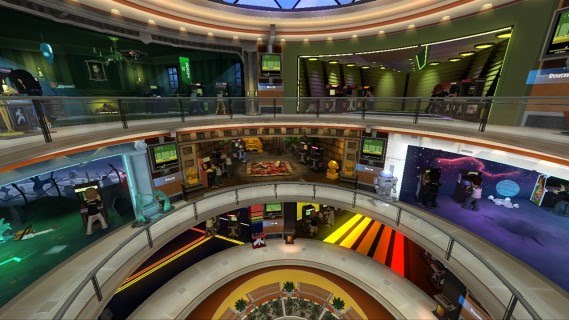

There are certainly things which Game Room does well. The idea for a single point of entry for old games rather than having them compete for space with other XBLA titles in your games library is a good one. Letting you design your own arcade, around which your friends' avatars wander, is quite neat, the emulation seems technically competent, and the addition of a Sands of Time style rewind feature is a great idea to allow those of us made soft by modern gaming to be able to get somewhere in the brutally unforgiving, often hopelessly unbalanced games of old.


However, Game Room shoots itself in the foot in several ways, the worst of which is the pricing model. Microsoft wants 240MSP (a little under R24 at current exchange rates) per game, or 400MSP (R40 or so) if you want to be able to play the game on PC or Xbox 360, which is far too much for such simple old games. It does allow you one free 10 minute game on each title, but the problem with retrogames is that, aside from a few classics, a lot of the time you only want to play them once or twice to remember what games used to be like and then try another title. This is why compilations work so well - when you are getting 30+ games for R150, it really doesn't matter if many of them have aged terribly, you can have a go at them, get your hit of nostalgia and then move on. You don't feel like you've wasted money on a poor game because within the context of the compilation, they all add to the experience, rather than having to justify a price by themselves. Being Xbox download titles, Game Room games won't discount over time, either. And where there is a game that was released as a standalone XBLA title in the past (Time Pilot and Scramble are the only two I'm aware of), they expect people to buy it again if they want to play it in Game Room. How hard would it have been to send people who purchased it originally an unlock code?


The choice of games isn't that great at the moment, either. While it does have some seminal games from the dawn of arcades (which was before even my time), such as Lunar Lander, Asteroids and Battlezone, a lot of the other games seem pretty random, and not really the best examples of classic gaming. I've discovered a lot of games I'd never seen or heard of which I quite enjoyed while playing various retro compilations, but after downloading seven game packs worth of titles for Game Room, there has yet to be a title that I thought hard about purchasing after the demo game. Maybe they plan to expand into later arcade eras (the late 80s or early 90s, perhaps) at a later stage, and with that will come more recognisable games.

You can visit friends' arcades, but to play the games they have bought costs virtual tokens (which you earn when other people visit your arcade), and this counts as demo play so it's limited to 10 minutes and your scores aren't saved for your friends to try and beat unless you have purchased the game yourself, so this feature, which could have mitigated the cost to an extent, doesn't really work very well.


I wonder then, if I'm not that taken with it, who is? I don't believe it has been a great success for Microsoft, but some people must be buying the games. I see each week on Major Nelson's LIVE activity charts that Game Room titles purchased usually collectively rank somewhere around 10th on the XBLA chart. I have no idea how many sales that actually is, but it is worth noting that all Game Room titles combined (at 240MSP each) are invariably below Castle Crashers on the chart, which costs 1200MSP and has been out for two years. In fairness, though, Castle Crashers is awesome.

Saturday, May 22, 2010

Pac-Man's 30th Anniversary

You may have noticed that Google has a pretty awesome playable tribute to Pac-Man in its logo (it even has a two-player option if you push the "insert coin" button). This is because this week marks the 30th anniversary of what is arguably the most recognisable videogame of all time.

I'm not going to try and explain the impact Pac-Man had on gaming, that has probably been done better than I would be able to, and I'm actually too young to have played Pac-Man in the arcades. However, I spent a bit of time playing the game late last year (the XBLA version on the Namco Museum Collection), and it's remarkable how well the game still stands up. As I seem to state in a lot of these posts, I enjoy retro-gaming, but a lot of old games rely on nostalgia and a "so bad they're good" factor now. Pac-Man, on the other hand, remains a challenging, well designed game, where repeated play actually sees you improving as you develop better strategies to go with improved reflexes. For a game released in 1980, that is quite a feat.

Namco have stated that they plan to release a new version of the game this year to mark the 30th anniversary. Having already made all the usual mistakes in updating old classics (trying to add storylines, making it into a 3D platformer) many, many years ago, their last Pac-Man game, 2007's Championship Edition, took the game in new directions without compromising the core of the game, so it will be interesting to see what the new one will be like. Rumours currently suggest a four-player game where Pac-Men have to eat each other as well as ghosts and dots. The new game will most likely be revealed at E3 this year.

Friday, November 13, 2009

The Problem with Digital Distribution

I don't think any of us would try to argue that digital distribution isn't the future of games retail. However, at the moment, there are a few things holding it back, often making digital purchases notably inferior to regular retail. One of the issues is simply bandwidth (although this is far less of a problem in the first world) and another is transferability (digital purchases are often locked to your PC or console, whereas you can lend a disc to someone), but what really sets them back is price. By doing away with the middlemen, and almost all of the physical costs of the product (no boxes, manuals, discs, freight charges), digitally distributed titles should be cheaper than conventionally marketed ones. However, this is seldom the case, and the lack of discounting causes significant price discepancies once a game has been out for a while.


Regular readers of this blog, or anyone who knows me in general, will know I am fascinated with retrogaming and the history of videogames. A little while back I bought a copy of the Namco Museum Virtual Arcade collection for the Xbox 360. Essentially, this is a collection of 9 games previously released onto Xbox Live Arcade (when the disc is in the drive, you can even select them from the games menu as if they were XBLA titles installed on your hard drive), as well as 25 other retro titles from Namco's back catalogue.

When Namco Museum Virtual Arcade was released on disc, it was probably a full price (or close to full price) title, but over time the price has gone down, and I bought it for £12.99, which was about R155 at the time of purchase (or 1530 MSP for the sake of comparison). Despite the fact that many of the games released on XBLA have been there for years (according to Wikipedia Pac Man was released on XBLA in August 2006), I believe that all of them are still at the full price they were released at. Even assigning no value to the other 25 games not previous released on the Xbox, the 9 XBLA titles included on the Museum collection alone come to 4800 MSP (£40.80 / R486), which is a pretty poor comparison, even if you could argue that a person might not choose to buy Pac Man as well as Ms Pac Man, or that you probably wouldn't want to buy New Rally X at all.


The problem with digitally distributed titles is that they are immune to the regular pressures of retail, as there is no cost to holding stock and therefore no real need to keep it cycling. This is great for the retailer, but not so good for the consumer. If you look at Microsoft's Games on Demand initiative, many of the games loaded onto the service cost more than a boxed copy now does at retail. Valve's Steam service is great for indie games and the occasional weekend deal, but the standard pricing on new titles is often higher than a boxed version. Until this is sorted out, digital distribution is not going to be able to make substantial progress in supplanting the retail games market.